Skills-First Hiring in 2026: How to Rewrite Your Resume for Skills-Based Screening
Skills-first hiring is no longer just a talent-strategy buzzword. Employers increasingly screen for demonstrated capability, tool familiarity, and transferable skill evidence rather than relying only on pedigree or job-title sequence. That change affects how resumes should be written in 2026.
This guide explains what skills-first hiring means for job seekers and how to rewrite a resume so it performs better in skills-based screening and AI-assisted recruiter workflows.
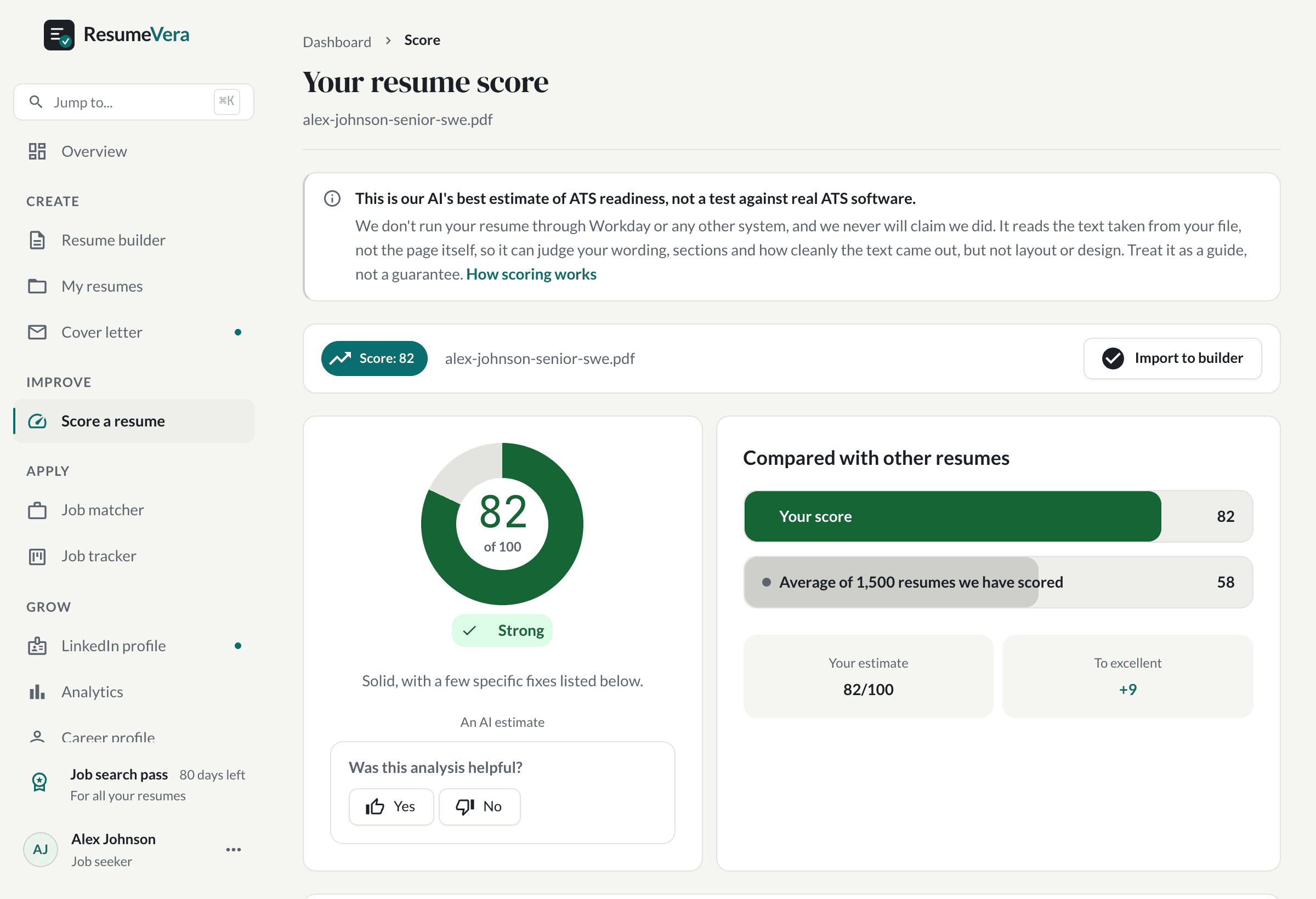
Resume rewrites are easiest to judge with an ATS check. After updating your skills positioning, test the full resume in ResumeVera.
Direct Answer: How should you rewrite a resume for skills-first hiring in 2026?
You should rewrite a resume for skills-first hiring by making role-relevant skills more explicit, proving those skills through measurable work or project bullets, and aligning the resume around capability clusters rather than vague job-history narration. The goal is to make your skills easy to identify, easy to trust, and easy to match to the job description.
What Skills-First Hiring Changes
- Skills sections matter more, but only when supported by evidence
- Projects and outcomes become more important for non-traditional candidates
- Transferable skills need concrete examples, not labels alone
- Exact skill wording increasingly affects AI and ATS matching
How to Rewrite Your Resume
- Start with the job description: identify the recurring skills, tools, and responsibilities.
- Rebuild the skills section: group your skills by function instead of listing random keywords.
- Rewrite bullets for proof: every skill in the skills section should appear somewhere in experience or projects.
- Use projects strategically: especially if you are a new grad, career switcher, or returning after a gap.
- Update the summary: mention the strongest capability cluster tied to the role.
Good vs Weak Skills Positioning
- Weak: Communication, leadership, teamwork, problem solving
- Better: Stakeholder communication, sprint planning, CRM ticket escalation, SQL reporting, Figma prototyping, GST reconciliation, preventive maintenance
The second version is more useful because it maps to actual work and actual roles.
Who Benefits Most from Skills-First Positioning?
- New grads with projects and internships
- Career switchers with transferable capabilities
- Candidates returning after a break
- Applicants from less-recognised institutions trying to compete on proof
Common Mistakes
- Adding a huge keyword list with no proof
- Using generic soft skills as filler
- Not matching skill wording to the job description
- Leaving projects underdeveloped
- Hiding transferable skills inside vague duties
Frequently Asked Questions: Skills-First Hiring 2026
What is skills-first hiring?
Skills-first hiring is an approach where employers screen more heavily for demonstrated capabilities, tools, and role-relevant evidence rather than relying only on degrees, pedigree, or past titles.
How should I change my resume for skills-first hiring?
Make skills explicit, organise them by function, and prove them through measurable project or work bullets that match the target role's language.
Are projects more important in a skills-first job market?
Yes, especially for new grads, career switchers, and candidates without long formal experience. Projects provide evidence when titles alone do not.
Do ATS systems care about exact skill wording?
Yes. Exact or near-exact wording still matters in most screening workflows, especially when recruiters search for specific tools, methods, and domain skills.
Should I remove education if hiring is skills-first?
No. Education still matters, but it should not be the only strong signal on the page. Skills-first resumes balance background with proof of capability.
Skills-First Resume Architecture
In skills-first screening, recruiters and AI tools look for explicit capability evidence. A good resume no longer relies on title history alone; it maps capabilities to proof quickly and unambiguously.
- Capability clusters: group skills by function (delivery, analysis, communication, tooling).
- Proof blocks: connect each cluster to outcomes from projects or roles.
- Context: show where the skill was applied (industry, scale, constraints).
- Recency: prioritise recent and role-relevant examples over older, weaker signals.
From Skills List to Skills Evidence
Weak
Skills: communication, leadership, project management, problem-solving.
Strong
Project delivery: coordinated cross-functional launch plan, tracked dependencies, and ensured milestone alignment across design and engineering. Analysis: translated user feedback patterns into prioritized backlog changes.
Job-Description Mapping Workflow
- Highlight repeated skill terms and capability phrases in the job post.
- Map each high-priority skill to one concrete bullet from your background.
- Replace generic wording with the role's terminology where accurate.
- Delete unsupported skill labels that have no proof in projects or experience.
- Reorder sections so strongest capability evidence appears above less-relevant history.
Transferable Skills for Career Switchers
- Operations to product: process optimisation, stakeholder updates, execution discipline.
- Support to success: issue diagnosis, retention communication, account ownership basics.
- Sales to growth: pipeline management, messaging iteration, conversion-oriented execution.
- Academic to professional: project ownership, research synthesis, structured delivery.
Skills-First Pre-Submission Checklist
- Each high-priority skill has at least one proof bullet.
- Summary mentions capability and direction, not just ambition.
- Experience bullets emphasize outcomes and scope, not task lists.
- Resume language mirrors the target role vocabulary naturally.
- Document reads clearly in under one minute for first-pass review.
Recruiter Review Simulation: 45-Second Scan
Most first-pass reviews are fast. A skills-first resume should communicate capability evidence within 45 seconds. Use this simulation to test whether your document survives real screening behavior.
- 0 to 10 seconds: Is your role target clear from headline and summary?
- 10 to 25 seconds: Do top bullets prove the core skills from the job description?
- 25 to 35 seconds: Are outcomes visible, not just task lists?
- 35 to 45 seconds: Is there enough context to trust skill depth and recency?
Capability Narratives for Different Candidate Types
New grads
Lead with project execution quality, practical tooling use, and reliability signals such as delivery timelines, testing discipline, or stakeholder collaboration.
Career Switchers
Translate prior domain experience into transferable capability language. Show where old strengths map directly to new role outcomes.
Experienced Professionals
Prioritize scale, cross-functional influence, and measurable improvement outcomes. Remove early-career details that dilute current positioning.
Common Skills-First Mistakes in 2026
- Adding long skills lists with no supporting bullets.
- Using buzzwords like "strategic" or "innovative" without examples.
- Keeping generic summary lines that could fit any role.
- Repeating identical achievements across multiple roles.
- Ignoring recency, resulting in stale skill emphasis.
Final Conversion Checklist
- Top third of resume contains your strongest proof, not background noise.
- Every critical job requirement appears as evidence at least once.
- Language is specific, concise, and role-matched.
- Removed unsupported claims and redundant bullets.
- Resume tells a clear capability story from start to finish.