Laid Off in 2026? Here's How to Rebuild Your Resume Fast
If you just got laid off, take a breath. You are not alone, and this is not the end of your career. It is a forced pivot, and how you handle the next few weeks matters more than the layoff itself.
In 2025, nearly 245,000 tech workers lost their jobs globally, with roughly 70% of those cuts coming from US-headquartered companies. The pace has only accelerated in 2026: through mid-year, over 185,000 workers have been impacted across 267 separate layoff events, averaging more than 1,000 job losses per day. Major companies like Amazon (16,000 cuts), Oracle (30,000 cuts), and Meta (another 10% workforce reduction) have led the headlines. And it is not just tech. Finance, media, retail, and healthcare have all seen significant reductions driven by AI adoption, restructuring, and shifting market conditions.
Here is the good news buried in that data: employers are still hiring aggressively, especially for roles that require human judgment, cross-functional collaboration, and domain expertise. The labor market is not collapsing. It is reshuffling. And people who rebuild their resumes quickly and strategically are landing interviews faster than you might expect.
Research from job market analysts shows that candidates who had been laid off within the past three months actually received interview callbacks at a rate of 5.74%, compared to 4.97% for currently employed candidates. A fresh layoff, handled well, is not the scarlet letter it used to be.
This guide will walk you through everything: what to do in the first 72 hours, how to rewrite your resume without panic, how to explain gaps confidently, and how to build a week-by-week recovery plan that gets you back to work.

The first 72 hours after a layoff: your action plan
The first three days after a layoff set the tone for everything that follows. You do not need to apply to jobs immediately, but you do need to protect yourself financially and organizationally. Here is what to prioritize:
| Timeframe | Action | Why it matters |
|---|---|---|
| Day 1 | Save all performance reviews, project documentation, work samples, and colleague contact information before you lose access to company systems | You will need this material to write strong resume bullets and get references |
| Day 1 | Review your severance agreement carefully before signing anything | Severance terms are often negotiable, and signing too quickly may waive rights under the WARN Act or limit your options |
| Day 1 | File for unemployment insurance through your state's Department of Labor website | Benefits typically replace 40-60% of prior wages and take 1-3 weeks to process, so file immediately |
| Day 1-2 | Understand your COBRA rights and evaluate health insurance options | You have 60 days to elect COBRA continuation coverage (up to 18 months), but you can also explore ACA Marketplace plans, which may be cheaper |
| Day 1-2 | Calculate your financial runway: savings, severance, unemployment benefits, and monthly expenses | Knowing your timeline removes panic and lets you make strategic job search decisions instead of desperate ones |
| Day 2-3 | Update your LinkedIn headline and enable "Open to Work" (visible to recruiters only) | Recruiters actively search for recently available candidates, and being visible immediately expands your reach |
| Day 2-3 | Reach out to 5-10 close professional contacts to let them know you are looking | Warm referrals account for a significant share of hires, and people want to help but they need to know |
| Day 3 | Start your resume rewrite using this guide | A strong resume within the first week positions you ahead of others who wait weeks to begin |
A note about the WARN Act
If your employer has 100 or more full-time employees and laid off 50 or more workers at a single site, they were required to give you 60 days of advance written notice under the federal WARN Act. If they did not provide this notice, you may be entitled to back pay and benefits for the notice period they skipped. Several states, including California, New York, and Illinois, have their own mini-WARN Acts with stricter requirements. Review your termination letter carefully and consult a labor attorney if you believe your rights were violated.
Why your old resume will not work anymore
Most people instinctively grab their last resume and start sending it out. That is a mistake. The resume you used to get your last job was written for a different version of you, a different market, and possibly a different career direction.
Here is what has changed:
- You have new accomplishments. Everything you achieved at your most recent job is missing from your old resume.
- The market has shifted. In 2026, 55% of US hiring managers expect layoffs to continue, and 44% cite AI as a top driver. Employers are looking for different skill combinations than they were even 18 months ago.
- ATS and AI screening have evolved. Newer systems evaluate semantic fit, evidence quality, and career trajectory, not just keyword matches. Your resume needs to prove skills, not just list them.
- Your target role may have changed. A layoff is sometimes the push you needed to pursue a role that better fits your strengths or interests.
You need a fresh resume built from the ground up. Not a quick edit. A strategic rebuild.
How to rewrite your resume after a layoff: step by step
Step 1: Gather your evidence before you write anything
Before opening a resume template, collect the raw material:
- Performance reviews and feedback from managers and peers
- Project briefs, launch announcements, and milestone summaries
- Metrics you influenced: revenue, cost savings, time reduction, user growth, error rates, NPS scores
- Tools, platforms, and technologies you used daily
- Teams you led, cross-functional groups you collaborated with, stakeholders you presented to
- Any certifications, training, or skills you developed during your tenure
This evidence becomes the foundation for strong resume bullets. Without it, you will fall back on vague descriptions that do not differentiate you.
Step 2: Define your target role clearly
A resume written for "any job" performs worse than a resume written for a specific type of role. Even if you plan to apply broadly, pick a primary target and optimize for it. You can create a second version later if needed.
Search for 5-10 job postings that interest you and look for patterns:
- What job title appears most often?
- What skills are listed as must-haves across multiple postings?
- What industry terms and business contexts keep appearing?
- What seniority level matches your experience?
Use these patterns to shape your resume's headline, summary, and keyword strategy.
Step 3: Write a summary that acknowledges your strengths, not your layoff
Your resume summary is not the place to explain your layoff. It is the place to explain your value. Write 3-4 lines that answer: what role do you fit, what is your strongest evidence, and what kind of company or problem are you best suited for?
Example:
Senior Marketing Manager with 7 years of experience driving B2B demand generation for SaaS companies. Skilled in paid acquisition, ABM strategy, HubSpot, and Salesforce reporting. Led campaigns that generated $4.2M in qualified pipeline over 12 months. Strong fit for growth-stage companies scaling their go-to-market engine.
Notice what is missing: any mention of a layoff, a gap, or a need for a job. The summary sells capability, not circumstance.
Step 4: Rewrite your bullets using the evidence formula
The single biggest improvement you can make to your resume is transforming weak, duty-based bullets into evidence-rich achievement bullets. Use this formula:
Action verb + skill or tool + business context + scale + measurable result
Before and after resume bullet examples
| Before (weak) | After (strong) |
|---|---|
| Managed a team of customer success representatives | Managed a team of 8 customer success reps across 120 enterprise accounts, improving net retention from 89% to 96% over two quarters |
| Responsible for data analysis and reporting | Built automated SQL and Python reporting pipelines for a 15-person sales team, reducing weekly reporting time from 12 hours to 2 hours |
| Helped with product launches | Co-led launch of a self-serve onboarding product used by 3,200 SMB customers in the first 90 days, contributing to $850K in first-quarter ARR |
| Created content for social media channels | Developed and managed LinkedIn and Instagram content strategy for a B2B SaaS brand, increasing organic engagement 47% and driving 340 qualified leads in 6 months |
| Worked on improving the checkout experience | Redesigned the e-commerce checkout flow using A/B testing and Hotjar heatmaps, reducing cart abandonment by 23% and increasing conversion rate from 2.1% to 2.9% |
| Supported the engineering team with QA testing | Executed test plans for 14 feature releases across 3 product lines, identifying 47 critical bugs pre-launch and reducing post-release defects by 31% |
The "after" versions work because they give both ATS systems and human recruiters something concrete to evaluate. Tools, scope, scale, and outcomes are all visible in a single line.
Rebuild your resume in minutes, not days
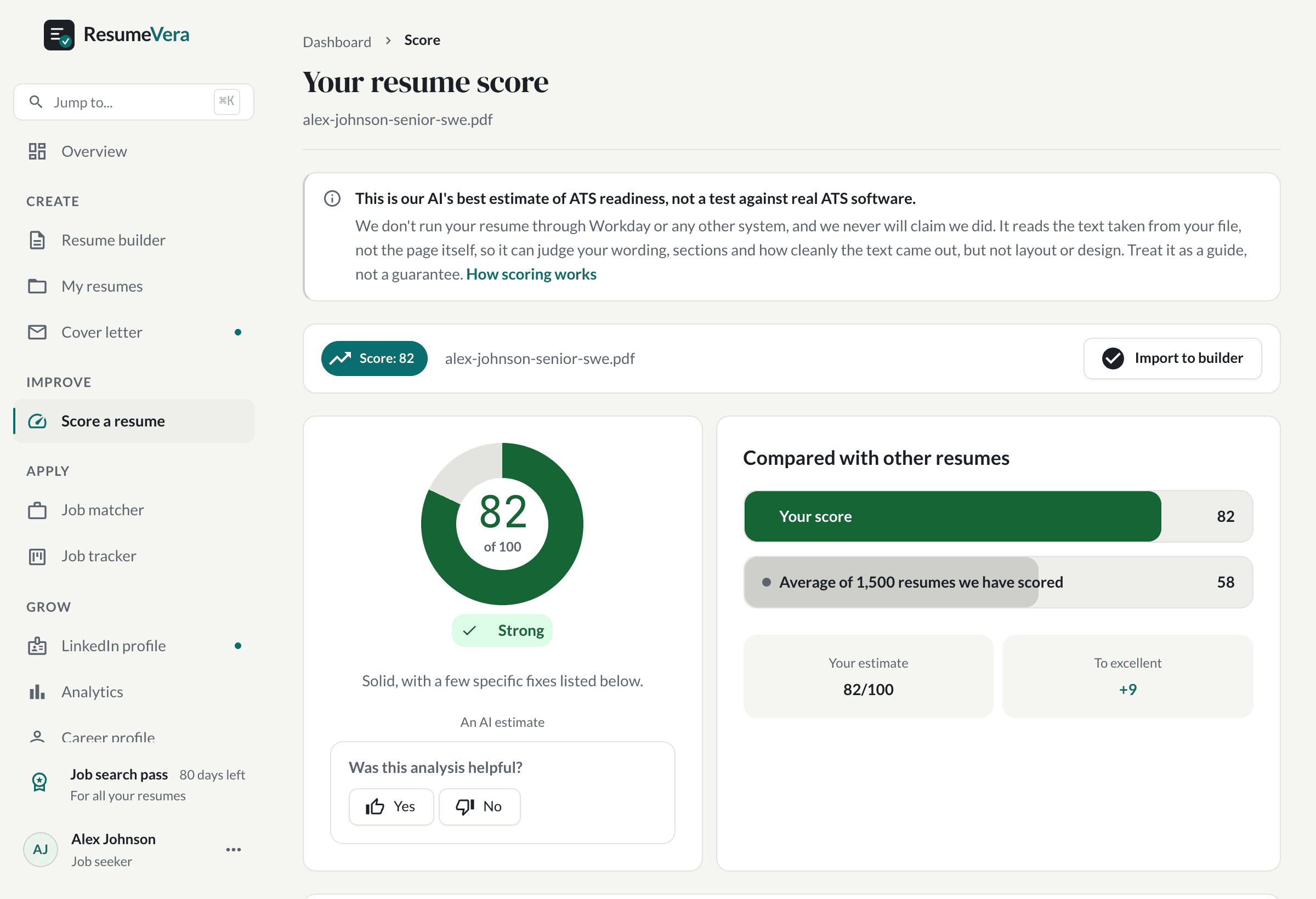
ResumeVera's free resume analyzer scans your current resume and shows you exactly what to fix: missing keywords, weak bullets, formatting issues, and ATS compatibility problems. Start your rebuild with a clear diagnosis.
Step 5: Handle your employment dates honestly
Do not extend your end date or list "Present" if you are no longer employed. If your layoff happened in May 2026, your resume should say "March 2023 - May 2026" or "Mar 2023 - May 2026." Honesty here is non-negotiable. Background checks routinely verify employment dates, and a discrepancy can disqualify you from consideration even after receiving an offer.
The gap between your end date and today is not the problem you think it is. Most hiring managers in 2026 understand that layoffs happen to strong performers. What matters is what you do with that gap, which we will cover next.
How to explain an employment gap on your resume
Over half of job seekers in 2025-2026 have at least a one-month employment gap on their resume. One in four has a gap of 12 months or longer. And 91% of hiring managers now say they are open to candidates with career breaks. The stigma is fading, but you still need a strategy.
If the gap is under 3 months
You probably do not need to address it on the resume at all. A short gap between jobs is normal and expected after a layoff. Focus on making your most recent role's bullets as strong as possible.
If the gap is 3-6 months
Add a brief line in your experience section showing what you did during the gap:
- Professional Development & Job Search | Jun 2026 - Present
- Completed Google Data Analytics Professional Certificate
- Contributed to two open-source projects on GitHub
- Freelanced on three marketing strategy projects for early-stage startups
If the gap is 6+ months
Treat the gap period like a role. Give it a title, dates, and bullets that show productivity:
- Independent Consultant & Career Transition | Jan 2026 - Present
- Completed AWS Solutions Architect certification and built three cloud migration case studies
- Provided fractional project management for a Series A fintech startup during product launch
- Attended 4 industry conferences and expanded professional network by 200+ relevant connections
The key principle: never leave a gap unexplained on a resume if it is long enough to raise questions. Fill it with real activity, even if that activity was learning, volunteering, or caregiving. A named gap beats a silent gap every time.
What to say in interviews about your layoff
Keep it brief, factual, and forward-looking. Here is a template that works:
"My role was eliminated as part of a company-wide restructuring that affected [number] positions. I'm proud of what I accomplished there, including [one specific achievement]. I've used the transition period to [one productive activity], and I'm now focused on finding a role where I can [specific value you bring]."
Do not badmouth your former employer. Do not over-explain. Do not apologize. Layoffs in 2026 are a structural reality, not a personal failure, and most interviewers know this.
Your week-by-week job search recovery timeline
Structure turns anxiety into progress. Here is a realistic recovery timeline for someone who has just been laid off:
Week 1: Stabilize and prepare
- Complete all items in the 72-hour action plan above
- File for unemployment insurance and understand your COBRA options
- Begin your resume rewrite using the evidence-gathering process
- Update your LinkedIn profile: headline, summary, and recent experience
- Make a list of 20-30 target companies and roles
Week 2: Build your materials
- Finish your primary resume, optimized for your top target role
- Write a flexible cover letter template you can customize per application
- Run your resume through an ATS resume checker to identify keyword gaps and formatting issues
- Prepare your layoff explanation (2-3 sentences, practiced out loud)
- Create or update your portfolio, GitHub, or work samples if relevant to your field
- Begin reaching out to your wider professional network
Week 3-4: Apply strategically
- Submit 5-10 tailored applications per week (quality over volume)
- Customize your resume summary and keywords for each application
- Follow up on networking conversations with specific asks
- Apply to roles on LinkedIn, Indeed, Glassdoor, and company career pages directly
- Attend one virtual networking event or industry webinar per week
- Start a simple tracking spreadsheet: company, role, date applied, status, follow-up date
Week 5-6: Expand and iterate
- Review your application results and adjust your resume if you are not getting callbacks
- Consider working with a recruiter in your industry vertical
- Explore contract, freelance, or consulting opportunities to fill the gap and generate income
- Begin interview preparation: research common questions for your target roles
- If you are pivoting to a new field, start a relevant certification or online course
Week 7-8: Intensify and diversify
- Broaden your target role list if initial results are slow
- Create a second resume version if you are pursuing two different role types
- Reach out to second-degree connections for informational interviews
- Practice behavioral interview answers using the STAR method
- Consider industries adjacent to your experience that may be hiring more actively
Week 9-12: Sustain momentum
- Maintain a consistent daily routine: applications, networking, skill-building
- Continue tracking and iterating on what is working
- If you are receiving interviews but not offers, focus on interview skills and ask for feedback
- If you are not receiving interviews, revisit your resume keywords and targeting
- Protect your mental health: schedule breaks, exercise, and social time
Resume formatting tips for laid-off professionals
Your resume format should make it as easy as possible for ATS systems, AI screeners, and human recruiters to understand your value quickly. Here are the formatting rules that matter most in 2026:
- Use a single-column layout. Multi-column designs break ATS parsing and scramble your content.
- Use standard section headings. Summary, Skills, Work Experience, Education, Certifications. Do not get creative with labels.
- Put contact information in the body, not headers or footers. Many ATS platforms cannot read header and footer content.
- Use reverse chronological order. Your most recent role first. This is what recruiters expect and what ATS systems parse most reliably.
- Keep it to 1-2 pages. One page if you have under 10 years of experience, two pages if you have more.
- Export as PDF unless the employer specifically requests DOCX.
- Use a clean, professional file name: Firstname-Lastname-Target-Role-Resume.pdf
Avoid tables for core content (though they are fine for supplementary information), avoid images or graphics, avoid text boxes, avoid decorative skill bars, and avoid any formatting that looks great in a design tool but turns into unreadable text when parsed by software.
Tailoring your resume for the 2026 job market
The 2026 job market has specific characteristics that should influence how you write your resume:
AI fluency is now a baseline expectation
With 44% of hiring managers citing AI as a top driver of layoffs, companies are looking for people who can work alongside AI tools, not be replaced by them. If you have used AI tools in your work, whether for data analysis, content creation, customer support automation, code generation, or workflow optimization, put it on your resume with specific examples.
Example bullet: "Implemented AI-assisted customer ticket routing using Zendesk AI, reducing average first-response time from 4 hours to 45 minutes and freeing the support team to handle 30% more complex escalations."
Human judgment skills carry a premium
As AI handles more routine tasks, employers place higher value on skills that AI cannot easily replicate: strategic thinking, stakeholder management, creative problem-solving, ethical judgment, and cross-functional leadership. Make sure your resume demonstrates these through specific examples, not just listed as skills.
Industry pivots are more accepted
Mass layoffs have normalized career transitions. If you are moving from tech to healthcare, or from finance to education technology, use a hybrid resume format that leads with a skills summary followed by chronological experience. This lets you highlight transferable skills before a reader notices the industry change.
Remote work experience is an asset
If you have experience working remotely or managing distributed teams, include it. Many companies are still building remote-first or hybrid cultures, and demonstrated ability to be productive and collaborative in remote settings is genuinely valuable.
Common resume mistakes after a layoff
Stress leads to bad decisions. Here are the mistakes laid-off professionals make most often, and how to avoid them:
- Sending out the old resume immediately. Your last resume is stale. Take a few days to rebuild it properly. A week of preparation is worth more than a month of applying with a weak resume.
- Mentioning the layoff on the resume. Your resume is a marketing document, not a confession. Do not write "laid off" or "position eliminated" anywhere on it. Save that context for interviews if asked.
- Applying to everything. Mass-applying with a generic resume leads to mass rejections. Target 5-10 well-matched roles per week with customized materials.
- Neglecting LinkedIn. Recruiters search LinkedIn before they search resume databases. If your LinkedIn does not match your resume and is not optimized for your target role, you are invisible to a major hiring channel.
- Inflating dates or titles. Background checks in 2026 are thorough. Do not extend employment dates, upgrade job titles, or fabricate metrics. One inconsistency can end your candidacy.
- Ignoring the skills section. Many ATS platforms use the skills section for initial keyword filtering. Include a dedicated skills section with tools, platforms, methodologies, and certifications that match your target roles.
- Writing a resume objective instead of a summary. "Seeking a challenging position in a dynamic company" tells a recruiter nothing. A summary with your role, experience level, key skills, and strongest achievement tells them everything.
- Forgetting to proofread. Typos and grammatical errors signal carelessness. Read your resume out loud, use a grammar checker, and have a trusted friend review it before you send it anywhere.
Using your severance period wisely
If you received a severance package, you have a financial cushion that many job seekers do not. Use it strategically:
- Invest in upskilling. A relevant certification (Google, AWS, HubSpot, Salesforce, PMP) can strengthen your resume and signal motivation during a gap. Many can be completed in 4-8 weeks.
- Take on freelance or consulting work. Even one or two small projects give you fresh material for your resume, fill the gap, and generate income. Platforms like Upwork, Toptal, and Fractional can connect you with short-term opportunities.
- Build something. A side project, an open-source contribution, a case study, or a portfolio piece demonstrates initiative and keeps your skills sharp.
- Network intentionally. Use your time advantage to have coffee chats, attend meetups, and reach out to people at target companies. Networking is harder when you are working full-time, so leverage the flexibility while you have it.
Remember: severance pay is taxed as regular income at the federal level, and unemployment benefits are also federally taxable. Plan your finances accordingly so there are no surprises at tax time.
Where to find jobs after a layoff in 2026
Do not rely on a single channel. The most effective job searches use multiple approaches simultaneously:
- LinkedIn Jobs: The largest professional network and a primary channel for recruiters. Optimize your profile first, then apply.
- Indeed: The highest-volume US job board. Good for broad searches and for companies that do not use LinkedIn as heavily.
- Company career pages: Many roles are posted on company websites before they appear on job boards. If you have a target company list, check their careers pages weekly.
- Networking and referrals: Employee referrals remain one of the most effective paths to an interview. Let your network know you are looking.
- Industry-specific boards: AngelList for startups, Dice for tech, Mediabistro for media, Built In for tech companies by city.
- Recruiters and staffing agencies: Particularly useful for mid-to-senior roles. Reach out to recruiters who specialize in your industry.
- Contract and gig platforms: Upwork, Toptal, and Robert Half can bridge the gap with paid work while you search for a full-time role.
Protecting your mental health during a job search
This section matters as much as the resume advice. A layoff is a loss, and it is normal to feel shock, anger, grief, self-doubt, or anxiety. These feelings do not make you weak. They make you human.
Practical strategies that help:
- Create a daily routine. Structure reduces anxiety. Set specific hours for job search activities and specific hours for rest.
- Set process goals, not outcome goals. "Apply to 5 jobs this week" is controllable. "Get 3 interviews this week" is not. Focus on what you can control.
- Stay physically active. Exercise is one of the most effective treatments for anxiety and depression. Even a daily 30-minute walk makes a measurable difference.
- Talk to people. Isolation amplifies stress. Stay connected with friends, family, former colleagues, and professional communities.
- Limit doomscrolling. Reading layoff trackers and recession predictions for hours does not improve your job search. Set boundaries on news consumption.
- Seek professional support if you need it. If your mental health is suffering significantly, many therapists offer sliding-scale fees, and some severance packages include EAP (Employee Assistance Program) benefits that cover counseling sessions.
The job search will end. The goal is to get through it with your confidence, health, and relationships intact.
Real talk: how long does it take to find a job after a layoff in 2026?
There is no single answer because it depends on your industry, seniority, location, and how actively you search. But here are realistic benchmarks:
- Entry to mid-level roles: 4-8 weeks with active searching and a strong resume
- Senior individual contributor roles: 6-12 weeks
- Management and director-level roles: 8-16 weeks
- Executive roles: 12-24 weeks or longer
- Career changers: Add 4-8 weeks to any of the above
These timelines assume you are actively applying, networking, and iterating on your materials. Passive searches take significantly longer. The fastest way to shorten your timeline is to start with a strong, targeted resume and treat your job search like a full-time job.
Get back on track with a professional resume
ResumeVera's AI-powered resume builder helps you create a polished, ATS-optimized resume in minutes. Start with your existing resume or build from scratch with guided prompts that turn your experience into strong achievement bullets.
Should you use a resume builder after a layoff?
Yes, and here is why: when you are stressed, decision fatigue is real. Staring at a blank document trying to figure out formatting, section order, keyword optimization, and bullet phrasing simultaneously is overwhelming. A good resume builder eliminates the formatting and structure decisions so you can focus on the content that matters: your achievements, skills, and the story you want to tell.
Look for a resume builder that:
- Uses ATS-friendly templates that parse cleanly
- Helps you match keywords to job descriptions
- Provides AI-assisted bullet writing that you can customize with your real metrics
- Exports clean PDF files
- Offers a free option so you can start without financial pressure
ResumeVera's resume builder and ATS resume checker are built specifically for this use case. You can analyze your existing resume, identify gaps, and generate a new version that is optimized for both AI screening and recruiter review.
Key industries hiring in 2026 despite layoffs
While some sectors are shedding jobs, others are actively expanding. If you are open to pivoting, consider these growth areas:
- Healthcare and biotech: Aging demographics and continued investment in drug development and health tech are driving consistent hiring.
- Cybersecurity: The talent shortage in cybersecurity continues, with hundreds of thousands of unfilled positions in the US alone.
- Clean energy and climate tech: Federal investment and corporate ESG commitments are fueling growth in solar, EV, battery, and grid infrastructure roles.
- AI infrastructure and operations: While AI is displacing some roles, the companies building and maintaining AI systems are hiring aggressively for engineering, operations, safety, and product roles.
- Education technology: The shift toward online learning and workforce reskilling continues to create opportunities.
- Government and defense: Federal and state government hiring remains steady, with strong job security and benefits.
The bottom line
Getting laid off is not a career ending event. It is a disruption that feels enormous in the moment but becomes a footnote in your career story if you handle it well.
Move quickly on the financial and logistical basics: unemployment insurance, COBRA, severance review. Then invest serious effort in rebuilding your resume from scratch, using evidence-rich bullets, honest dates, and clear targeting for the roles you actually want.
Do not apologize for the layoff on your resume. Do not panic-apply to hundreds of random jobs. Do not sit on your old resume hoping it still works. Instead, treat your job search like the structured, strategic project it needs to be. The professionals who recover fastest from layoffs are not the ones with the most experience or the best connections. They are the ones who start rebuilding immediately and improve their approach every week.
You have the skills. You have the experience. Now you need a resume that proves it. Start by analyzing your current resume for free, and build from there.
Frequently Asked Questions
Should I mention being laid off on my resume?
No. Your resume is a marketing document, not a career history disclosure form. Do not write "laid off," "position eliminated," or "company downsized" anywhere on your resume. Save that context for interviews, where you can explain it briefly and professionally. Your resume should focus entirely on what you accomplished and what you can offer.
How soon after a layoff should I start applying for jobs?
Give yourself one to two weeks to handle logistics (unemployment insurance, COBRA, severance review) and rebuild your resume properly. Applying with a weak, outdated resume wastes opportunities. A strong resume submitted in week two will outperform a rushed resume submitted on day one. Use the first week to prepare, and start targeted applications in week two or three.
How do I explain an employment gap from a layoff?
For gaps under three months, you usually do not need to address them on the resume. For longer gaps, add a line showing productive activity: certifications, freelance projects, consulting, or professional development. In interviews, keep your explanation brief: state the layoff was part of a broader restructuring, share one accomplishment from the role, and pivot to what you have been doing since and what you are looking for.
Should I accept a lower-level job after a layoff?
It depends on your financial situation and career goals. Taking a step down can make sense if it gets you into a growing company or a new industry you want to explore. But be cautious about roles significantly below your experience level, as they can make it harder to return to your previous seniority later. Contract or freelance work at your level is often a better bridge than a permanent step down.
How do I handle references after being laid off?
Reach out to former managers, team leads, and close colleagues from your most recent role and ask if they would be willing to serve as references. Most people are happy to help, especially when the separation was a layoff rather than a performance issue. If your direct manager was also laid off, they can still serve as a reference. Avoid listing HR departments as references since they typically only confirm dates and titles.
Is it okay to use AI tools to write my resume?
Yes, but use AI as an editor and organizer, not as the author of your experience. AI tools are excellent for identifying keyword gaps, improving bullet structure, and checking formatting. However, the specific metrics, project details, and accomplishments on your resume must be real and yours. AI-generated resumes that lack specific, verifiable details perform poorly in interviews.
How many jobs should I apply to per week?
Quality matters more than volume. Aim for 5-10 well-targeted applications per week, with your resume customized for each role's keywords and requirements. Mass-applying to 50 jobs a week with a generic resume produces worse results than applying to 8 roles with a tailored resume. Track your applications and follow up appropriately.
What if I was laid off from a well-known company?
A layoff from a recognizable company can actually work in your favor. It carries brand recognition on your resume, and large-scale layoffs at major companies are well-documented public events, so there is no stigma attached. Emphasize the strong work you did there and the skills you developed. Recruiters understand that layoffs at major companies are business decisions, not performance judgments.
Sources and further reading
- Network World: Tech Layoffs Surpass 45,000 in Early 2026
- NerdWallet: AI-Driven Tech Layoffs in 2026
- US Department of Labor: COBRA Continuation Health Coverage FAQs
- Indeed: How To Address Being Laid Off on Your Resume
- Gallup: US Workers Continue to Report Downsizing
- LayoffAlert: 2026 WARN Act Notices, Statistics and Trends