Can recruiters tell if your resume was written by ChatGPT?
Resume Tips · ResumeVera Editorial · June 19, 2026 · 14 min read

In 2026, the question is no longer whether people use ChatGPT to write resumes. They do. Nearly 65% of job seekers now use AI tools in their applications, according to a 2025 CNBC report citing Career Group Companies' market trend data. Some surveys put the number even higher once you count researching companies, drafting cover letters, or writing resume bullets.
The real question is whether recruiters can tell. And if they can, does it hurt your chances?
The short answer: yes, experienced recruiters can often identify AI-generated resumes, and many count unedited AI output against a candidate. A 2025 Resume Now survey found that 62% of employers reject AI-generated resumes that lack personalization. Roughly a third of recruiters say they can spot an AI resume in under 20 seconds.
But the picture is more nuanced than a blanket ban. Recruiters do not hate AI assistance. They hate lazy AI output. This guide breaks down exactly what gives a ChatGPT resume away, what recruiters actually look for, and how to use AI as a writing assistant without torpedoing your candidacy.

How common is ChatGPT resume writing in 2026?
AI resume writing has moved from niche to mainstream in under two years. Here is a snapshot of the numbers:
| Statistic | Figure | Source |
|---|---|---|
| Job seekers using AI in applications | 65% | Career Group Companies, 2025 |
| Employers expecting AI in most or all hiring stages by 2026 | 62% | Resume.org survey |
| Employers rejecting AI resumes that lack personalization | 62% | Resume Now AI Applicant Report |
The irony is striking: both sides of the hiring table are now using AI. Recruiters use AI in hiring. Candidates use AI to write. But the expectations are asymmetric. Employers want efficiency from their AI tools. They want authenticity from yours.
Can recruiters actually detect ChatGPT resumes?
Yes, many can, and faster than you might expect. Detection is not based on running your resume through an AI detector tool. Recruiters tend to rely on pattern recognition developed from reading thousands of resumes.
According to Willo's 2025 analysis of AI resume detection, recruiters identify AI-generated content through several consistent signals. A Gem recruiting report confirmed that about one in three recruiters say they can flag an AI resume in under 20 seconds, and of resumes flagged as AI-generated, 62% were rejected in 2025.
Here is what triggers the red flag.
1. Generic buzzword saturation
ChatGPT has a signature vocabulary. When you ask it to write resume bullets, it reaches for the same words every time: leverage, spearhead, drive, innovative, dynamic, cutting-edge, passionate, results-driven, cross-functional synergy, and strategic alignment. Recruiters who read hundreds of resumes notice when dozens of them use the same adjectives in the same order.
The word delve has become something of a meme in recruiting circles. It appears in ChatGPT output at a rate far higher than natural human writing. Similarly, phrases like tapestry of experience or fostering a culture of innovation are almost never written by humans in the context of a resume.
2. Vague accomplishments with no specifics
An AI-generated resume loves to say things like:
Spearheaded cross-functional initiatives to drive innovative solutions and optimize stakeholder collaboration, resulting in significant improvements to organizational efficiency.
This sentence contains zero information. No company name context, no metric, no timeline, no tool, no outcome you can verify. A recruiter reading this knows it could describe anyone at any company doing anything. It is the resume equivalent of a horoscope.
Real resume bullets anchor claims in reality: Reduced customer onboarding time from 14 days to 6 days by rebuilding the intake workflow in Salesforce, saving the support team 22 hours per week.
3. Uniform sentence structure
ChatGPT tends to produce bullets that follow the same grammatical template: Action verb + adjective + noun + prepositional phrase + result clause. When every single bullet on a resume follows this pattern with mechanical regularity, it reads like output, not writing.
Human-written resumes have natural variation. Some bullets are short. Some start with context. Some lead with the result. The rhythm is uneven because real thinking is uneven.
4. Mismatch between resume polish and interview performance
This is the detection method recruiters talk about most in private. A resume arrives with flawless, eloquent language. Then the candidate gets on a phone screen and cannot articulate what they did in the role. The gap between the written document and the spoken answers is the strongest signal that someone else, or something else, wrote the resume.
5. Fabricated or implausible details
Large language models occasionally generate plausible-sounding details that are not real. A ChatGPT resume might reference a company name that does not exist, a tool that was never used at that company, or a certification that the candidate never earned. When recruiters verify these details, the application is dead.
This is especially dangerous because the candidate may not even notice. If you paste your experience into ChatGPT and ask it to enhance your resume, it may embellish or invent details that feel close enough to skip over during review.
6. Formatting artifacts
Raw ChatGPT output sometimes contains markdown characters like hash symbols, asterisks, or bullet formatting that does not translate cleanly into a Word document or PDF. These artifacts are immediate tells. A recruiter who sees stray markdown in a submitted resume knows exactly what happened.
What recruiters actually think about AI resumes
Recruiter attitudes toward AI-written resumes are not uniformly negative, but they are more skeptical than most candidates assume. The data paints a clear picture:
| Recruiter attitude | Percentage | What it means for candidates |
|---|---|---|
| Reject AI resumes lacking personalization | 62% | Generic AI output is the primary problem, not AI use itself |
| Can spot AI resume in under 20 seconds | 33% | One in three recruiters identify AI content almost instantly |
The pattern is consistent: recruiters do not object to candidates using AI as a tool. They object to candidates submitting unedited AI output as a finished product. The distinction matters. Using ChatGPT to brainstorm bullet points, overcome writer's block, or structure a professional summary is seen as resourceful. Pasting the raw output into a template and hitting submit is seen as careless.
Do AI detection tools work on resumes?
Several companies now market AI detection tools for recruiters, including GPTZero, Originality.AI, and others. But the effectiveness of these tools on resumes is limited.
AI detectors work by analyzing statistical patterns in text: perplexity (how surprising the word choices are) and burstiness (how much sentence length and complexity vary). Human writing tends to be more variable. AI writing tends to be more uniform.
The problem is that resumes are inherently formulaic. They use action verbs, industry jargon, and compressed sentence structures by convention. This means that even a fully human-written resume can trigger a false positive on an AI detector. A GPTZero guide for recruiters acknowledges that detection tools should not be used as the sole basis for rejecting candidates.
Many experienced recruiters do not rely on detector software. They rely on their own judgment, informed by years of reading resumes. The signals they look for are contextual, not algorithmic: does this resume sound like a specific person describing specific work, or does it sound like a language model generating plausible text?
The 10 biggest red flags in a ChatGPT resume
Here is a consolidated checklist of the signals that make recruiters suspect AI authorship. The more of these your resume shows, the more likely a recruiter is to suspect AI.
- Overuse of "leverage," "spearhead," "delve," "innovative," and "dynamic": these words show up far more often in ChatGPT output than in human writing.
- Every bullet follows the same grammatical structure: verb-adjective-noun-prepositional phrase, repeated line after line.
- No specific metrics, dates, tools, or company context: accomplishments are described in sweeping generalities.
- Perfectly polished language that sounds like a press release: resumes are professional documents, not marketing copy.
- Buzzword density exceeds content density: more adjectives than facts.
- Summary section reads like a LinkedIn headline generator: "Results-driven professional passionate about leveraging cutting-edge solutions."
- Inconsistency between resume language and candidate's actual communication style: tested during phone screens.
- Markdown artifacts or formatting inconsistencies: hash marks, stray asterisks, or font mismatches from copy-paste.
- Generic skills section that matches the job description too perfectly: every keyword mirrored without evidence of actual use.
- Suspiciously comprehensive coverage of every requirement: the resume addresses every bullet in the job description in order, a pattern that suggests prompt-based generation.
How to use ChatGPT for your resume without getting flagged
The goal is not to avoid AI entirely. That ship has sailed. The goal is to use AI as a drafting assistant while keeping your resume authentic, specific, and distinctly yours. Here is a practical framework.
Step 1: Start with your raw material, not a prompt
Before opening ChatGPT, write down your actual accomplishments in plain language. Do not worry about sounding professional. Just capture what you did:
- "I fixed the onboarding emails that were confusing new users. Open rates went from 22% to 41%."
- "I managed the migration from Salesforce Classic to Lightning for our 85-person sales team."
- "I cut the monthly close process from 12 days to 7 days by automating three reconciliation steps."
These raw notes contain the specific details that make a resume credible. ChatGPT cannot invent them. You must supply them.
Step 2: Use AI to polish, not to generate
Give ChatGPT your raw bullet and ask it to make the language more concise and professional. Do not ask it to "write resume bullets for a marketing manager." That produces generic output. Instead:
"Rewrite this resume bullet to be more concise and professional. Keep all the specific details: 'I fixed the onboarding emails that were confusing new users. Open rates went from 22% to 41%.'"
The output will be grounded in your real experience because you provided the facts.
Step 3: Remove ChatGPT fingerprint words
After generating a draft, do a find-and-replace pass for known ChatGPT vocabulary. Replace or remove:
- Leverage: replace with "use," "apply," or remove entirely
- Spearhead: replace with "led," "built," "launched"
- Delve: replace with "analyzed," "investigated," "explored"
- Innovative / cutting-edge: remove or replace with the specific technology name
- Dynamic: remove; it adds nothing
- Passionate about: remove; show passion through results, not adjectives
- Results-driven: remove; prove it with actual results instead
- Synergy / synergize: replace with "collaborated with" or name the specific teams
- Tapestry: remove; this word has no place on a resume
- Utilize: replace with "use"
Step 4: Inject variation into sentence structure
Read your bullets out loud. If they all start with an action verb followed by an adjective followed by a noun, break the pattern. Some techniques:
- Start a bullet with the result: "41% increase in onboarding email open rates after redesigning the 6-email welcome sequence."
- Start with context: "During the Salesforce Lightning migration, trained 85 sales reps and reduced post-launch support tickets by 60%."
- Use a short, punchy bullet: "Cut monthly close from 12 days to 7."
- Vary bullet length: mix one-line and two-line bullets naturally.
Step 5: Add details only you would know
The strongest defense against AI detection is specificity that a language model could not generate. Include:
- Exact tool names and versions: "Migrated 340 reports from Salesforce Classic to Lightning Experience" instead of "Led CRM migration."
- Team sizes and org context: "Managed a 6-person analytics team reporting to the VP of Revenue Operations."
- Precise metrics: "Reduced customer churn from 8.2% to 5.1% over three quarters" instead of "significantly reduced churn."
- Project names or internal references: "Led Project Atlas, a 9-month platform rewrite serving 2.3M monthly active users."
- Business context: "During the post-acquisition integration of [Company], consolidated two Workday instances into one."
Step 6: Verify everything
Read every line of your final resume and confirm that every claim is true and verifiable. If ChatGPT added a tool you have never used, remove it. If it inflated a metric, correct it. If it invented a responsibility, delete it. Verification is not optional. It is the step that separates responsible AI use from resume fraud.
ChatGPT resume vs. human-written resume: side-by-side comparison
Here is what the difference looks like in practice:
| Element | Unedited ChatGPT output | Human-edited version |
|---|---|---|
| Professional summary | "Results-driven marketing professional with a passion for leveraging innovative digital strategies to drive brand awareness and spearhead cross-functional campaigns that deliver measurable ROI." | "B2B SaaS marketer with 6 years running paid acquisition and lifecycle campaigns. Managed $1.2M annual ad budget across Google, LinkedIn, and Meta. Reduced CAC from $340 to $185 over 18 months at SeriesB-stage fintech startup." |
| Work bullet | "Spearheaded the development and implementation of innovative content marketing strategies, leveraging cutting-edge SEO techniques to significantly enhance organic visibility and drive substantial increases in web traffic." | "Rebuilt content strategy around 45 bottom-funnel keywords. Published 60 articles in 8 months. Organic traffic grew from 12K to 38K monthly sessions; pipeline from organic grew 140%." |
| Skills section | "Digital Marketing, SEO, SEM, Content Strategy, Data Analytics, Cross-functional Leadership, Strategic Planning, Stakeholder Management" | "Google Ads, LinkedIn Campaign Manager, Meta Ads Manager, GA4, Ahrefs, HubSpot, Salesforce, SQL (basic), Figma (for ad creative briefs)" |
The human-edited version is shorter, more specific, and harder to fake. It names real tools, real numbers, and real business context. A recruiter reading it can picture the actual work. A recruiter reading the ChatGPT version can only picture a language model.
What about ATS systems? Does AI-written content affect ATS?
Applicant tracking systems do not currently detect or penalize AI-generated content. ATS software parses and stores resumes so recruiters can search them by keyword, skill, and job title. It does not analyze writing style or statistical text patterns.
However, there is an indirect risk. ChatGPT resumes tend to be heavy on buzzwords and light on specific, searchable terms. A recruiter searching an ATS database for Snowflake, dbt, cohort analysis will not find your resume if ChatGPT replaced those terms with cutting-edge data solutions.
The best approach is to check your resume's ATS compatibility after editing. Tools like ResumeVera's free ATS checker analyze keyword coverage against specific job descriptions and flag gaps that generic AI language may have created.
For a deeper guide on keyword strategy, see our article on shadow ATS keywords that recruiters search but candidates miss.
Industry-specific risks of ChatGPT resumes
The risk of detection varies by industry and role level. Here is how it breaks down:
High detection risk
- Creative roles (writing, marketing, communications): Hiring managers in these fields evaluate writing quality as a core skill. A generic, AI-sounding resume is a disqualifier because it suggests the candidate cannot write.
- Senior and executive roles: At the director level and above, resumes are expected to reflect strategic thinking and a unique professional narrative. AI-generated summaries that could describe anyone are especially obvious.
- Small companies and startups: With fewer applicants, recruiters spend more time on each resume and are more likely to notice patterns.
Moderate detection risk
- Technical roles (engineering, data, IT): Recruiters focus more on technical skills and project details. AI language in soft-skill descriptions may be noticed but is less likely to be a dealbreaker if the technical content is solid.
- Mid-level professional roles: Resume volume is high enough that recruiters scan quickly, but experienced recruiters still flag obvious AI patterns.
Lower detection risk (but still present)
- Entry-level and high-volume roles: recruiters move quickly through large volumes. Detection is less likely, but generic AI language can still keep you out of a recruiter's keyword search results.
- Roles at companies that use AI tools in hiring: Some employers use AI to summarize or match applications. Generic buzzwords give those tools, and the recruiter reading their output, little to work with; specific tools, numbers, and context give them more.
The right way to use AI in your resume workflow
Think of ChatGPT as a writing partner, not a ghostwriter. Here is a workflow that produces strong, authentic resumes with AI assistance:
- Brainstorm accomplishments manually. Write down 3-5 achievements per role in your own words, including specific numbers, tools, and context.
- Use AI to refine language. Feed your raw bullets to ChatGPT and ask it to make them more concise and professional. Keep all specific details.
- Remove AI fingerprints. Scan for known ChatGPT vocabulary and replace with natural alternatives.
- Vary the structure. Break up repetitive sentence patterns manually.
- Add unique details. Insert project names, team sizes, tools, timelines, and business context that only you would know.
- Check ATS compatibility. Run your resume through an ATS analyzer to ensure your keywords are specific enough to match real job descriptions.
- Verify every claim. Read the final resume line by line and confirm every statement is accurate.
- Test with a read-aloud. Read your resume out loud. If any sentence sounds like something you would never actually say in a conversation, rewrite it.
Make your resume sound like you, not like ChatGPT
ResumeVera analyzes your resume for AI-sounding language, missing keywords, and ATS compatibility issues. Get specific, actionable feedback in seconds.
What happens if you get caught?
The consequences of submitting an obviously AI-generated resume range from mild to career-damaging, depending on the context:
- Immediate rejection: The most common outcome. Your resume goes into the no pile without further review. You never hear back.
- Blacklisting from the ATS: Some companies flag candidates in their ATS database. This can affect future applications to the same organization.
- Damaged reputation with recruiters: Agency recruiters talk. If a recruiter submits your AI-generated resume to a client and it gets flagged, that recruiter is unlikely to work with you again.
- Interview embarrassment: If the resume gets through but you cannot back up the language in an interview, the disconnect is obvious and awkward. Interviewers who suspect AI authorship may probe with detailed follow-up questions designed to test whether you actually did the work described.
- Offer rescission: In extreme cases where the AI-generated resume contains fabricated credentials or inflated accomplishments that are discovered during background checks, job offers can be withdrawn.
The ethical line: when does AI help become dishonesty?
There is a meaningful difference between using AI to write better and using AI to misrepresent yourself. Here is where the line falls for most US employers:
| Acceptable AI use | Questionable AI use | Unacceptable AI use |
|---|---|---|
| Using AI to improve grammar and clarity | Having AI rewrite your entire resume from scratch | Submitting AI output without reading or verifying it |
| Asking AI to make a bullet more concise | Using AI to generate accomplishments you did not achieve | Using AI to fabricate credentials or certifications |
| Using AI to brainstorm action verbs | Copying AI-generated content verbatim without editing | Using AI to create fake company names or work history |
| Running your resume through AI for feedback | Having AI write a summary that overstates your seniority | Using hidden text or keyword stuffing generated by AI |
| Using AI to tailor keywords for a specific role | Relying on AI without checking for accuracy | Using AI to impersonate a different professional background |
The principle is straightforward: AI should help you communicate your real experience more effectively. It should not help you communicate experience you do not have.
Will AI detection get better or worse?
AI detection technology is in an arms race with AI generation technology, and generation is winning. As language models improve, their output becomes harder to distinguish from human writing. The statistical signatures that current detectors rely on are becoming less reliable with each model update.
However, recruiter detection based on content quality is likely to remain effective. No matter how fluent the language model becomes, it cannot generate the specific, verifiable details of your actual work experience. The fundamental tell is not the writing style. It is the absence of real information.
This means the best long-term strategy is the same as the best short-term strategy: use AI to polish your real content, not to generate content from nothing.
What US recruiters wish candidates knew about AI resumes
Here is what recruiters commonly say about AI-written resumes:
- We are not anti-AI. Many recruiters use AI tools themselves. They understand the technology. They just want candidates to use it thoughtfully.
- Generic resumes were a problem before ChatGPT. AI made it faster to produce a bad resume, but the underlying issue, lack of specificity, has always been the main reason resumes fail.
- We care about the interview, not just the resume. If your resume is polished and your interview answers are vague, the gap tells us everything. Be able to discuss every claim on your resume in detail.
- Specific beats sophisticated. A plainly written resume with real numbers and real tool names beats an eloquent resume full of buzzwords every time.
- Tailoring matters more than ever. With AI making it easy to mass-apply, recruiters value resumes that show genuine alignment with the specific role and company.
Building a resume that sounds human in 2026
The candidates who succeed in the current hiring landscape are not the ones who avoid AI entirely, and they are not the ones who outsource their resume to AI entirely. They are the ones who combine AI efficiency with human authenticity.
Your resume should pass three tests:
- The ATS test: Does it parse cleanly and use the job's own keywords, so a recruiter searching their ATS can find it? Use an ATS resume checker to check.
- The recruiter test: Does it sound like a real person describing real work? Read it out loud and check for AI-sounding language.
- The interview test: Can you talk about every single bullet point in detail? If not, rewrite it until you can.
The best resume in 2026 is one that uses every available tool, including AI, to communicate what is genuinely true about your professional experience. That is not a limitation. It is the whole point.
Sources and further reading
- CNBC: Nearly Two-Thirds of Job Candidates Are Using AI in Their Applications
- Resume Now: AI Applicant Report, 62% of Employers Reject AI-Generated Resumes Without Personalization
- Resume.org: 1 in 3 Companies Anticipate AI Running Entire Hiring Process by 2026
- Willo: 11 Tips to Spot AI-Generated Resumes
- Gem: How to Detect AI-Generated Resumes
- GPTZero: How to Check if a Job Applicant Used AI
Written and checked by ResumeVera Editorial. How we research and review
Questions
Frequently asked questions
Make your resume sound like you, not like ChatGPT
ResumeVera flags generic, AI-sounding phrasing, missing keywords and formatting an ATS may misread, so you know what to rewrite.
Score my resume freeGet free ATS tips every week
Actionable resume and ATS tips, when we publish them. No spam. Unsubscribe any time.
Related Articles

Federal Resume vs Private Sector Resume: Key Differences Explained (2026)
Learn the major differences between federal and private sector resumes. Understand USAJOBS requirements, OPM formatting rules, specialized experience, KSAs, and common mistakes to avoid when applying for US government jobs.
Read More

Best Resume Format for US Jobs in 2026: The Complete Guide to Layouts, Sections, and ATS-Friendly Formatting
Discover the resume format preferred by US recruiters and ATS systems in 2026, including the optimal layout, correct section order, formatting best practices, and a detailed comparison of chronological, functional, and combination formats with real examples.
Read More

Certifications on Resume 2026: How to Show Continuous Learning Without Clutter
Learn how to list certifications, online courses, micro-credentials, and continuous learning on your resume. Includes formatting rules, examples by role, in-progress credentials, expired certificates, and ATS keyword advice.
Read More
Try it
Check this against your own resume
The post above is general. Your file is not. The checker reads it the way a parser would and tells you which of these points it actually breaks.
Check your resume free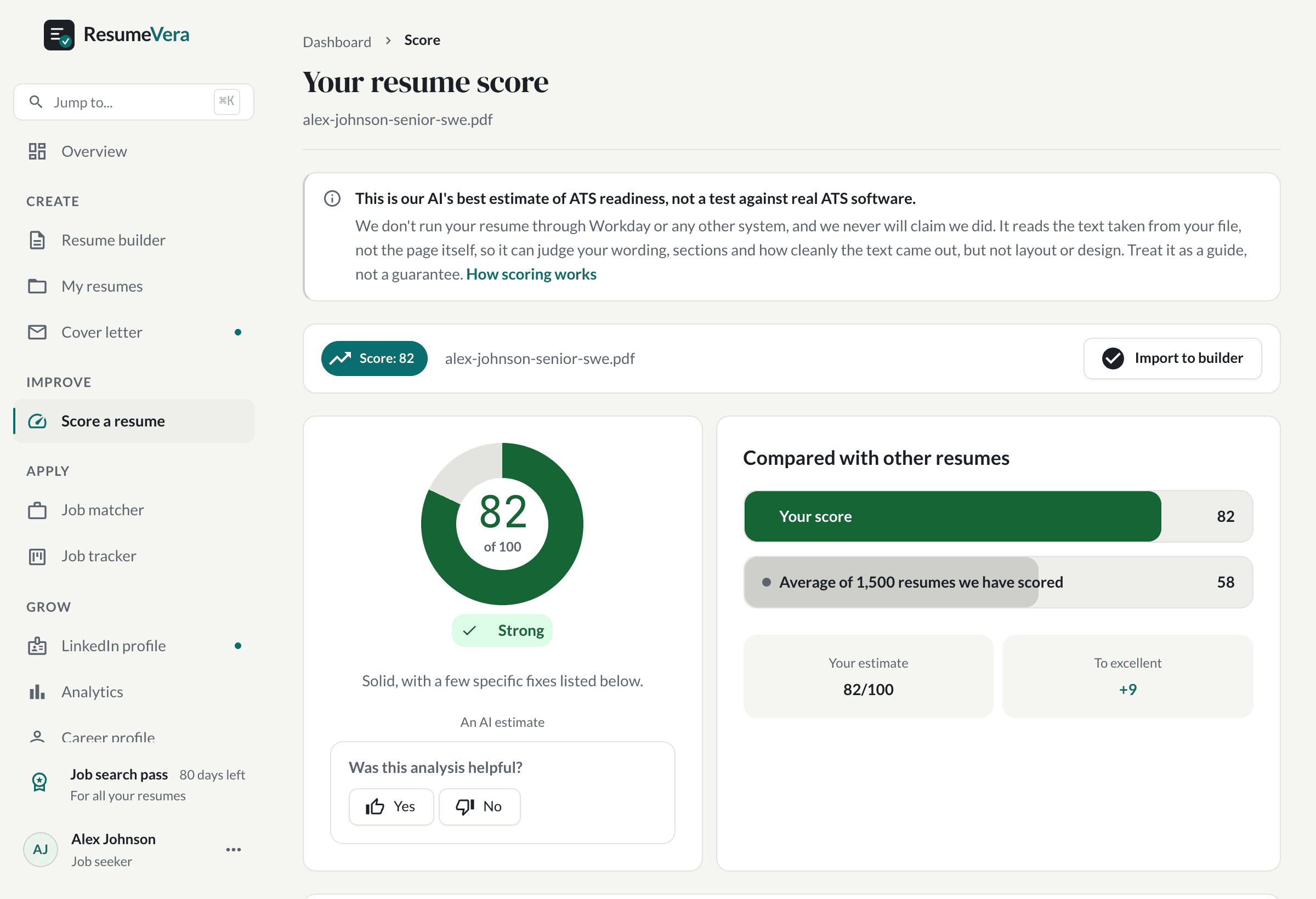
The real score page, with a sample resume and sample scores.
Now check it against your own resume
An honest resume score in seconds. No account, no card.